EN 15085 and ISO 3834 certified welding
Two standards govern how this shop welds. One covers fusion welding quality in general. The other qualifies a works to weld safety-critical railway assemblies. Together they are the reason a quality engineer can put our joints in front of an inspector.
ISO 3834 — FUSION WELDING QUALITY
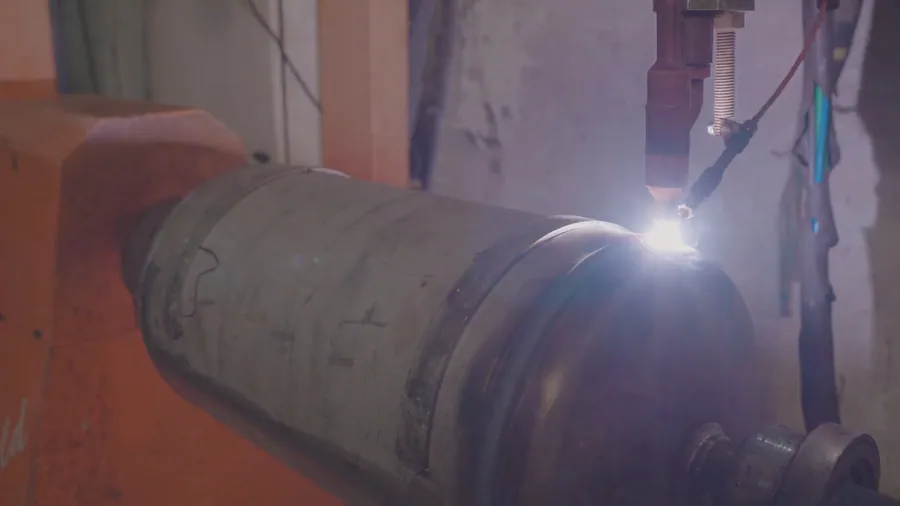
ISO 3834 sets the quality requirements for fusion welding of metallic materials. It is not a test of how a weld looks. It governs how every weld is planned, controlled, inspected and recorded: whether the procedure was qualified for that joint in that material, whether the welder was qualified to run it, whether the parent material was traceable, and whether the result was written down.
Any shop can produce a weld that passes a visual check on the day. ISO 3834 is the difference between that and a joint whose history can be reconstructed two years later when something is being investigated.
EN 15085 — WELDING OF RAILWAY VEHICLES
EN 15085 is the European standard for the welding of railway vehicles and components, and it is applied well beyond Europe — in India, China, Japan and Australia. It certifies the manufacturer, not the part: the works itself is audited and recognised as competent to weld safety-critical rolling-stock assemblies.
Very few Indian fabrication shops hold it. It requires a responsible welding coordinator, qualified procedures and welders for the specific joints, and a quality system an auditor can walk through. It is the accreditation that lets us build brake and underframe assemblies rather than only the vessels that sit on them.
What certification changes about the job
- The weld procedure is qualified before anything is cut
- A WPS is written for that joint in that material and thickness, and a PQR proves the procedure produces a sound joint. The welder who runs it holds a current qualification for that procedure. None of this happens after the fact.
- Material is booked against your job, not against a shelf
- Plate and fittings are recorded against the job number when they arrive, so what went into your vessel stays traceable to your vessel.
- Every joint is inspected, and vessels are tested
- Visual inspection on every weld, dimensional inspection against your drawing, and leak and pressure testing on pressure envelopes. All of it in house.
- The file ships with the vessel
- The documentation pack — procedures, qualifications, material identity, inspection and test results — goes out with the goods. If the file is not ready, the vessel is not ready.
Frequently asked
- Is Sakshi Tools EN 15085 certified?
- Yes. Railway vehicle and component welding is carried out under EN 15085, alongside ISO 3834 for fusion welding quality, ISO 9001:2015 for quality management and ISO 14001 for environmental management.
- What is the difference between ISO 3834 and EN 15085?
- ISO 3834 covers fusion welding quality across any application. EN 15085 is specific to railway vehicles and components and certifies the manufacturer to weld safety-critical rolling-stock assemblies. A shop doing railway work is normally expected to hold both.
- Can you supply certificates for our vendor file?
- Yes. Ask and we will send the current certificates, along with the welding procedures and welder qualifications relevant to your job.
- Do you weld to customer or third-party inspection?
- Yes. Tell us who inspects, and at which hold points, and that goes into the quotation rather than being discovered later.
- Which welding processes do you run in house?
- GTAW (TIG), GMAW (MIG/MAG), SAW for long girth seams, SMAW, and resistance and projection welding. Cutting, forming, rolling and dished ends are also in house.
Sakshi Tools is certified to ISO 9001:2015, ISO 14001, ISO 3834 and EN 15085. Current certificates are sent with the quotation, or on request for your vendor file.
Send us the drawing and we will tell you the truth. Request a quote →